Thursday, March 11, 2010

Context Rox


R.C. Harvey's examination of "Lorelie Rox" illumines (no pun intended) details of the story that we discussed in class, with the added benefit of some context, but he doesn't break much new ground. It doesn't take an extremely insightful reader to notice what an important role lighting plays in the opening pages of this story, but it helps to know Eisner's impetus for pushing the medium as much as he did. It's hard not to respect the man more for returning from war and still feeling that humor serves an important role in storytelling, for having the drive to present "fables, modern morality dramas [...] the supernatural, the inexplicable [...] science fiction [...] music [...] and poetry," all under one banner. It's not a shame that he left his monumental creation to push the medium in different directions, only that more creators couldn't learn from his work. Even the most progressive writers since Eisner -- Moore, Ellis, Morrison -- don't always maintain the narrative clarity that Eisner kept hold of throughout his experimental works. Maybe they should try a stint in the army.

Thursday, March 4, 2010

Love, Hate, and then there's RASL


Jeff Smith had an almost impossible task ahead of him. How does a self-publishing legend, a critical darling, and a beloved all-ages creator begin work on a new project?

Well, evidently by going for a dark atmosphere over substance and shipping once every three or four months.

Allow me to clarify: I didn't dislike RASL, but I didn't particularly like it either. It's not a bad comic by any stretch of the imagination, but I wouldn't label it excellent unless you're obliged to worship anything Smith puts out. I'm going to start with the bad, since I am a pessimist.

Three over-sized issues in, I don't understand the seemingly-central plot device. The "Drift" has not only been under-explained, but under-depicted. I struggled to make sense of the oblong shape in the sea of black ink that shows up when the titular character makes a trip through the Drift. I'm a firm believer that science-fiction needs to be handled in a variation of two ways: either the story revolves around an excellent science-based idea and plot, or you must explain away the science to focus on the story at hand. RASL doesn't really commit to either. Smith wants to tease us with small hints of the science at hand, including some clunky explanatory scenes in the third issue, but he has yet to do more than add strange element after strange element. On the flip-side, his character plots have remained almost completely intertwined with the sci-fi elements, making it difficult to connect to characters due to gaps in understanding about the way RASL's universe operates. The Native American plot and the art thief angles could be welcome, fresh elements in this sci-fi tale, but Smith hasn't made much of either yet.

Additionally, it can come across that Smith is just trying too hard not to be "the Bone guy." Carrying a "suitable for mature audiences" warning, Smith tries to darken RASL in clunky ways that don't contribute to the narrative, such as the exposed breasts of the prostitute(?) that RASL sleeps with and his strip club visit. I'm not sure that either added to my understanding of RASL, but these sort of elements might work well if not for Smith's inability to sufficiently depart from his Bone art style. While no creator should be forced to write just one type of story, the medium of comics calls for different visual styles to suit different storytelling tones. Writers have free range to work with the most suitable artists, but artists and cartoonists need to be able to adapt to different moods visually. The vagabond that RASL meets in the third issue looks ripped right from the world of Bone, to humorous effect. The eponymous character, however, spends much of his time looking like a "Yu-Gi-Oh" character with the fullest hair a woman could ever hope for. There are also scenes where his anatomy is downright bad (I defy you to explain away RASL's pose and figure on page 17 of the collected volume in any rational manner). Much of the issue stems from inconsistency; the RASL of pages 29 and 53 is not the same wasp-waisted RASL of page 38, let alone the freakishly long-armed RASL of the opening sequence.

Consistency also comes into play when you consider the slow-boil plot. Mainstream comics are in an age of decompressed storytelling, where plots and events drag out over months. This kind of slow pacing might be considered expertly done if the book had a regular shipping schedule, but publishing six issues in two years doesn't qualify the book as possessing such. I have the benefit of reading a collected volume (and I have a sneaking suspicion that the glowing major publication reviewers quoted on the back cover did as well), but I can guarantee that I would have called it quits with this title after the first hiatus. Even this collected volume feels like a Hail Mary to keep interest alive in some form, as it certainly doesn't include a full story arc of any sort.

Now Sour Steve is going to exit the blogosphere for a moment so that Sunny Steve can write a few positive notes.


RASL succeeds in several ways. As a book with an unusually large page size, RASL has the challenge of justifying its unique format. Here, Smith does a good job by allowing for wide, open panel designs. RASL is so sparsely populated by characters that the expansive panel deisgn helps to make the feeling more intentional. The desert of the first few pages wouldn't work as well if it weren't so blindingly white and open, and scenes like pg. 19's explosion benefit from the space alloted.

RASL is billed as a "sci-fi noir," and Smith makes occasional use of the noir aspect to great benefit, laying on heavy inks as on the image from pg. 18 that was swapped for the cover, or the first meeting with the lizard-like assassin pages later. Scenes like the latter also benefit from Smith's restraint with dialogue. The book features little narration, focusing instead on allowing the action to speak for itself. Often very kinetic, the layouts are never difficult to follow. I'm disappointed that this focus seems to disolve as the book goes on (compare the first struggle with the lizard man to the last), but Smith might very well strike a balance in future issues.

At the end of the day, RASL offers something very different, both from Smith's previous output and from the majority of books published each month. Its unhurried pace, intriguing (if inconsistent) visual style, striking use of black and white, and decently fresh science fiction devices, RASL might very well be looked back on fondly. Perhaps I'm just not the target audience, as I didn't grow up with the self-publishing boom and its resulting storytelling styles. The most grevious error, in my mind, is the inability to ship the product in a manner that complements the plot's decompression. This volume didn't offer me enough to want to stick around for the years it might take for the series to payoff, but I certainly think more committed fans will find aspects to enjoy.

Thursday, February 25, 2010

ORIGIN-al


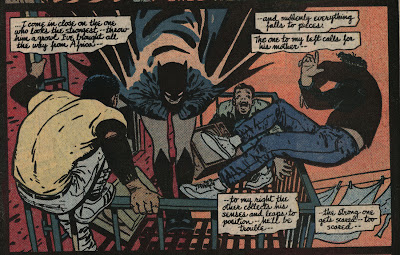
There are many tropes at work in superhero comics: reboots, retcons, crises, time travel, and origin stories, to name a few. Many of these blend together, and all run the risk of raising the ire of finicky fans who secretly fear any change in characters they knew as children. That's why the stunning commercial and critical success of Batman: Year One is so impressive. Frank Miller, who would go on to produce several truly awful Batman stories in his life (really, just plain atrocious), provides a definitive, grounded origin of the Bat in four issues and says more about Bruce Wayne and his world than many Batwriters do in years.
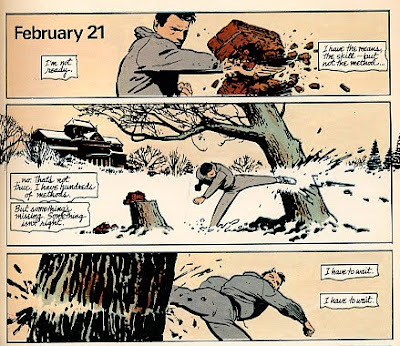
The essential quality at work here is the realism. DC has long made its claim to fame with iconic heroes who often seem larger than life. Somehow, despite having a world populated with aliens, Amazons, and ring-slingers, a highly trained, highly analytical, borderline obsessive vigilante is one of their most popular characters. Miller latches onto this and removes any ludicrous elements from his tale, showing Bruce Wayne in his earliest, roughest days, sweat suits and all. When the chances of a mystical or cosmological deus ex machina are removed, the consequences feel more real to the reader. We can believe that Batman might take punches and feel pain because we know he has never shot a God in the chest. We feel that corrupt cops present a viable threat because no anthropomorphic crocodiles are terrorizing the city.

Perhaps more importantly, Miller chooses to contextualize Batman in ways that are often pushed to the side in favor of more ridiculous fare. Gotham City works well as a setting because it isn't a real place, allowing artists to get a bit more creative and symbolic. In the hands of many creators, Gotham becomes a stereotypical "dark city," but in the hands of Miller's genius collaborative partner David Mazzucchelli, Gotham is Chicago, Detroit, New York, and something else entirely rolled up in one. The slums and tenements feel like they belong in a real city instead of a movie set.

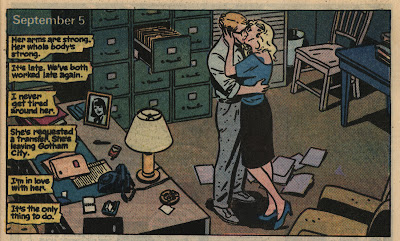
The inhabitants of the city are given renewed purpose as well. Undeniably Miller's best choice, setting up James Gordon as a direct parallel to Batman keeps the origin story from becoming repetitive or indulgent. His rise and fall is an essential sense of perspective for readers seeing a masked man jumping between rooftops. Adding the element of Gordon's affair with Detective Essen gives him what every hero needs: a flaw, and a chance for redemption. This is particularly impressive when you take into account that Miller's tale is set years before countless other Batman stories, seemingly forbidding Miller from advancing the characters in any significant way beyond what we already know.


Then there is the matter of what is known, namely the rogues. While much of Year One's success rests with its realism, removing too many aspects of the character makes one beg the question, why use the character at all? The new "Human Target" television series on FOX is "based" on a comic book, but its central premise is gone. The movie version of Wanted shared about 5 minutes of similarities with the comic, so why was it even called "Wanted"? Miller's most recent Batman work, All-Star Batman & Robin, the Boy Wonder, is pretty much a Sin City story featuring characters in Batman costumes, and his proposed Batman/ Al-Qaeda match-up really shouldn't even be discussed.
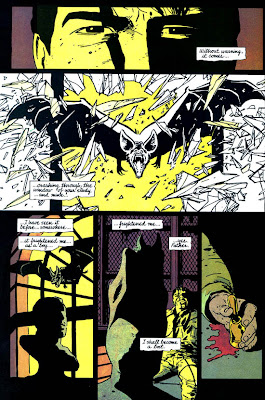
Thankfully, we see enough of what we know here to avoid falling into this trap. While Miller's casting of Selina Kyle as a prostitute was retconned (probably for the best), she does have a healthy role in the series, foreshadowing her romantic tango with Bats years later. Harvey Dent's tragic downfall starts within these pages, lending extra gravity to the relationship he has with Bruce. Of course, no one could forget the deliciously tantalizing final lines of the series, finally followed up on in 2005 and ripped directly from the page for the closing scene in the film Batman Begins. All of these elements combine to show us that we really are seeing the gestation of a fictional world, one that is a few steps outside of our own but not so far off that we can't comprehend its workings.

Of course, Year One left a lasting legacy at DC. Although (re: Thank God) the non-Miller/Mazzucchelli Year Two was stricken from continuity, very little from this tale has been contradicted. A host of other DC characters have recieved the "Year One" treatment, including the Bat-family's own Batgirl (excellent), Nightwing, Robin, and Huntress; Green Arrow (fantastic artwork by Jock); Metamorpho (thumbs down); Teen Titans (fun and inconsequential); the big guns, JLA; and Black Lightning (surprisingly good -- and needed). Joe Casey, long-time writer for the Big Two and smaller companies, recently said that he would do away with all of the frequent "tags" we assign to comics, including "Year One," but it can't be denied that fans like to be filled in on the gaps in time of their favorite characters (seriously, though, who thought Metamorpho needed this?). If they were all as successful as Batman: Year One, then I say bring them on.
Jones. Desolation Jones.


The elements of Warren Ellis' script for Desolation Jones #1 that are most apparent are trust and respect. Ellis trusts J.H. Williams III enough to move quickly through his descriptions, leaving much of the interpretation open to Williams III. I have read Ellis' scripts for other artists and I can attest that he writes to suit the level of artistic experience he is working with. Williams III has worked with Howard Chaykin, Greg Rucka, Grant Morrison, and even Alan Moore -- he hardly needs to be coddled.

Ellis obviously has a very distinct version of our world in mind throughout this story, yet he leaves so many visual cues up to Williams III to decide. A more controlling writer would spend pages agonizing over the details of the world he has imagined in his head, but Ellis acknowledges that this comic is a collaboration. He takes time to lay out plot-specific details, such as the titular character's key visual traits, settings that impact the story, and background props that come into play, but he trusts Williams III to figure out how to bend perspective, have a road melt into a map, and design tools for the hunt of living steak. If Ellis envisions a panel where a character's profile mirrors that of an x-ray, he includes the description; if he needs a character to seem a bit paranoid and troubled, he knows that Williams III can depict that without much guidance.

I'm sure, however, that Ellis' scripts were not always like this. His writing style now speaks with a confident voice, that of a scripter who knows his artist's capabilities and focuses instead on dialogue and plotting. When he first began working for 2000 AD with a host of talented but unseasoned artists, I am sure he overwrote a bit to make sure that his ideas were carried across. Did he ever hit Mooresque heights of script detail and control? I'm not sure, but I am glad that he has been able to hone his craft down to its most essential parts. Not only is he going to increase his own effeciency, he is going to constantly challenge and improve the quality of his artists. Especially when he is writing about Hitler porn.

Wednesday, February 17, 2010

Q. When is a Main Character Not a Main Character?


A. When the creators are nervous about working with icons.

Of course, who am I to talk? No one has ever plopped a legendary character in my lap and said, "go for it." From a young age, however, I have been crafting my own stories with characters that hold iconic status the world over. Whether it was with action figures in hand, on my mother's old typewriter, or in script programs on a Macbook, I have always tried to understand the unique nature of characters that pass from creator to creator. As I've studied this in practice, a certain "tell" has become noticeable. Many creators, even big, bankable names, have been known to take on classic characters in eponymous books and tell stories that focus on anything but the classic character.

A good perennial example of this is the Vertigo title Hellblazer. The long-running book was first written by Jamie Delano and is now a consistent low-seller, but the book hasn't neared cancellation because it's a good venue to test out new writers at such a small imprint. While the main character may be John Constantine (no resemblance to the awful movie iteration), he is often little more than a lens into whatever fantastic situations or antagonists writers come up with. John Constantine, instead of being a long-established character, is really a cipher.

But enough of 'ole John. Denny Colt has his fair share of time out of the spotlight to deal with. Let us look at the sixth issue of Darwyn Cooke's run, in which the Spirit appears in only a few pages as he listens to the story that he largely missed. I enjoyed the issue, and I felt that the writing and the art were both strong, but there was nothing dictating that it be a Spirit story. Any detective or good-doer could have been substituted in with no ill effect.

Looking at Cooke's collaboration with Jeph Loeb, (in)famously hot and cold writer, we can see a similar, but not identical case unfolding. In this Eisner-award winning one-shot, which sparked enough interest to garner a Spirit ongoing written and drawn by Cooke, Loeb plays heavily on the similarities between the Batman and the Spirit to create a feasible (in comic book sense) reason for the characters to meet. As Batman and the Spirit both have close connections to police commissioners and colorful rogues galleries, the story centers around a grand team-up of the rogues to crash a police ball that brings the crime-busting forces of Gotham and Central City to one place. Though it is an oversized issue, Loeb spends the majority of the time fleshing out the characters of Commissioners Gordon and Dolan and planting the seeds of deception and seduction with Catwoman (a character that Cooke helped to redesign and reinvent) and P'gell (one of the many sultry women to cross the Spirit's path). Batman is nearly wordless throughout much of his appearance (as is completely in character) and the Spirit doesn't have much of a character at all, beyond being a bit less intelligent and a bit more eager than Bats. Cooke's art, complemented by the inkwork of J. Bone and the colors of Dave Stewart, harkens back to the period from which the Spirit emerged without being drenched in noir trappings. The story is fun and no gross mischaracterization is perpetuated, but at the end of the day, the titular characters are secondary to the supporting cast.

Loeb is always either a whiz at cutting right to the core of characters (see: Batman: The Long Halloween, Superman: For All Seasons, the "color" books) or a fiend for taking a massive dump on any previous characterization at the extreme disservice of the finished product (see: anything under the Ultimate banner, the first 12 or so issues of Hulk). Here he walks a fine line between servicing the legacy and actually adding to the mythos. Is that all we can hope for? Even Alan Moore and Neil Gaiman, when they tackled the character for a series published by Kitchen Sink Press entitled The Spirit: New Adventures, wrote the hell out of every character except for the damn Spirit! Moore's contribution, drawn by his Watchmen collaborator Dave Gibbons, retells the Spirit's origin -- by telling the origin of three ancillary characters involved. Gaiman's focuses on a sadsack writer who happens to accidentally help the Spirit out on a case. Both stories are beautifully written, feature wonderful art and some of the most inventive titles I have ever seen (Gibbons spells using breakfast items), but they were little more than love notes that were afraid to sully what came before by adding something readers might not agree with. While Will Eisner classically used the character as a vessel to tell stories about many colorful secondary characters with some very poignant notes, he did so without sacrificing actual characterization of the hero. The only other real attempt I have seen at deepening Denny is Frank Miller's movie, and nothing about that could be deemed a success (notice how I never say anything nice about comic book movies?).

As the Spirit prepares to be reintroduced by Brian Azzerello and Rags Morales in the pages of DC's New Wave, he'll also receive his own title written by Prince Valiant news strip scripter Mark Shultz. That (admittedly underwhelming) news, however, was dulled when Shultz spoke to Jeff Renaud at CBR and let it be known that he would depart the title after only three issues, citing too much on his plate. Is he also concerned about the weight of writing such a renowned character? Possibly not, as he made it known that the trademark humor of the series would take a backseat to darker tales featuring the character, a sign that comic fans have learned to fear. Then again, I have to wonder how many fans the Spirit even has. With half a century since his debut, long periods out of the limelight, whole generations of fans that know nothing about him, an awful movie adaptation, several false starts, and a seeming lack of characterization, what fan base is the Spirit holding onto, and how long will it last?

Tuesday, February 9, 2010

Shadowy Origins, or How I Learned To Stop Worrying and Love Plagiarism.

I'm going to come out and say something:

Stealing is okay.

I mean, don't get me wrong, you shouldn't steal money or really cool shoes, but ideas are up for grabs. The fantastic thing about the idea ether that we all seem magically connected to is that we are all connected to it. The upside is that we can all take a crack at ideas. The downside is that our attempt may pale in comparison to another's. When Rob Liefeld departed Marvel and created (among other "original" works) his rip-off of the Hulk called "Smash" (No, really), no one cared. Making a purple Hulk does not improve upon the idea of the Hulk (but three female Hulks, a red one, and a barbarian version does -- oh, just Wiki it).

When Bill Finger and Bob Kane took all of the Shadow stories they had loved and put the lead character in a more ridiculous costume, rechristening him "The Batman," they were introducing the world to an improved, or at least more contemporary and marketable, version of the dark vigilante concept. Whether their success owes more to the fact that you could see, rather than only read, Batman's adventures, or to the changing public perception of escapism and entertainment (likely, a bit of both), one concept was embraced and another was allowed to slowly disappear.

Of course, the Shadow is not gone. He was allowed his own godawful movie adaptation (but isn't Alec Baldwin great now?) and he has sporadically appeared in comic books of his own. If rumors are to be believed, we will get to watch a new crack at the character as directed by Sam Raimi in a few years. Maybe this new version will stick and the character will make a come back, and maybe it won't. While we all owe the Shadow, his creator, and his defining writers credit for inspiring Batman, we long ago made our choice of preferred nighttime crusader.

Besides, trying to spot the inspirations behind every popular idea would drive anyone crazy...

Thursday, February 4, 2010

Spirited Away

The astounding thing about reading Will Eisner's The Spirit is the timelessness. I'm striving to find a word that really captures what I mean, but words just can't sum up the place this work still holds in the canon of comics. In many ways, the uneducated would probably place these stories much later on the timeline of comics than the 1940's.

Eisner defies his time of origin with an art style that takes the best of his animation background and mixes in fine art skills and a sense of what works and what fails on the page. This seemingly effortless knowledge isn't possessed by many today; the way that Eisner allows his images to tell stories on their own could deliver a much-needed lesson to the overbearing writers to emerge after Stan Lee's revolution. While much of the credit is certainly due to Eisner being a cartoonist (i.e. writing and drawing instead of working in tandem with another creator), the restraint is still remarkable. Fight scenes are given the space to speak for themselves, and internal narration only ever complements images, never struggles for dominance. Whereas cracking open a Chris Claremont issue of X-Men will reveal captions and thought balloons that explain, in detail, everything occurring on panel, Eisner wisely uses his narration to explain things that can't accurately be portrayed through art: changes in speed and sound, thoughts that the thinker wishes to hide from those around him, etc.

Eisner also lays down a foundation for panel staging that has only recently (relatively speaking) been expanded upon, and even now with mixed results. Eschewing the legacy of comic strips, which often featured pure side shots of characters, scenes that are akin to adjacent animation cells, Eisner panned his "camera" to suit his story. I was blown away by the panel that features the titular character recovering from a punch at the far end of the panel, the bulk of the space taken up by wood flooring. This panel expertly, but subtly, communicates the distance the punch sent him, the spatial relationships between characters, and the implied movement (if only Frank Miller hadn't "directed" an awful film version a while back, I might have a chance to find an example of such a panel online). Eisner manages to preemptively break out (literally and figuratively) of the constrictions that later artists will adhere to concerning panel structure. Mixing "widescreen" layouts with small squares panels, allowing certain panels to have differing borders or none at all, Eisner layed down a groundwork that wouldn't be seen again in mass form until decades later.

As for his noir style, the influence is obvious and practical. Eisner's style was at once cartoony and meticulous, and the heavy "shadows" (re: inks) allowed him the time to focus on what would be shown. In sharp contrast to the almost offensively bright superhero adventures that would fill the pages for years to come, Eisner's Spirit used shadows to guide the eye, to focus attention, and to create tension. For years, this sense of light was lost to the medium, but Eisner nailed it in his first few outings. Most importantly, and something that creators still often fail to capture, Eisner does it all with a sense of fun. It is evident from the outset, as his covers often playfully acknowledge the medium by having characters interact with the typography of the page. Not willing to try to pass off a subpar imitation of another medium (film, animation), Eisner makes a bold statement that comics is a singular medium capable of its own path and its own style. How much of that style saw its first appearance here wouldn't be evident for years to come, but it is inescapable now.